
Injection molding manufacturers are under constant pressure to deliver faster cycle times, higher precision, and reduced costs. Traditional tooling methods, while reliable, often struggle to keep pace with the complexity of modern product designs. This is where future molds—built with metal 3D printing and artificial intelligence (AI)—are redefining the landscape. These technologies not only optimize performance but also unlock design possibilities that were previously unattainable.
Introduction
Injection molding manufacturers are under constant pressure to deliver faster cycle times, higher precision, and reduced costs. Traditional tooling methods, while reliable, often struggle to keep pace with the complexity of modern product designs. This is where future molds—built with metal 3D printing and artificial intelligence (AI)—are redefining the landscape. These technologies not only optimize performance but also unlock design possibilities that were previously unattainable.
Conformal Cooling: Metal 3D Printing for Advanced Cooling Channels
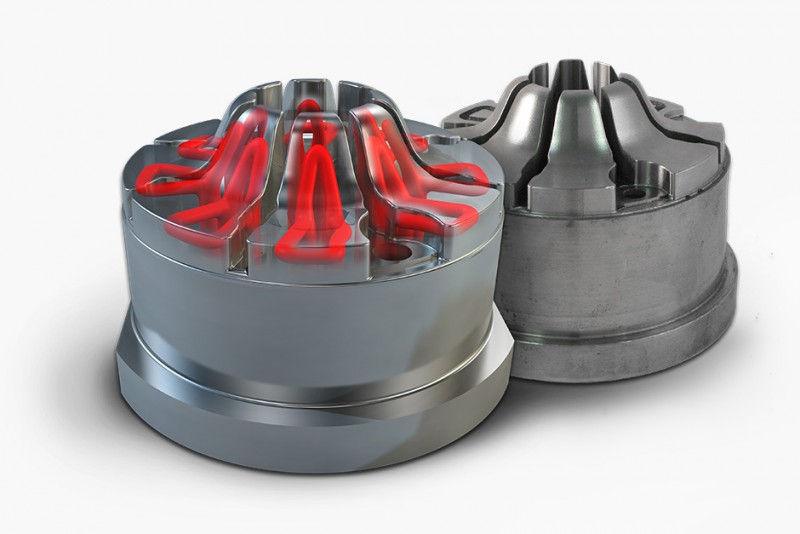
Conformal cooling is a breakthrough enabled by metal 3D printing, allowing cooling channels to follow the exact geometry of the molded part.
· Compared to conventional straight-line drilling, conformal cooling reduces cooling time by 30–40%.
· In automotive applications, this approach has cut surface warpage by 25%, improving dimensional accuracy and reducing scrap rates.
· The practical impact: manufacturers can increase throughput without investing in additional machines, directly boosting profitability.
AI-Driven Injection Simulation
Injection simulation is already a cornerstone of mold design, but the integration of AI takes it further:
· AI algorithms can rapidly evaluate thousands of scenarios, predicting defects such as voids or weld lines before physical trials.
· Studies show AI-enhanced simulation reduces trial iterations by up to 50%, saving both time and development costs.
· Example: in medical device housings, AI-driven simulation improved pressure distribution and reduced fracture risk by 20% compared to traditional methods.
Hybrid Molds: Combining Machined and 3D Printed Components
Hybrid molds merge the precision of conventional machining with the flexibility of metal 3D printing.
· Critical surfaces are machined for accuracy, while complex cooling channels or intricate cavities are 3D printed.
· Industrial results show hybrid molds reduce lead times by 20–30% while maintaining durability.
· Example: in electronics manufacturing, hybrid molds enabled fine structures with conformal cooling, improving product quality and reducing rejection rates by 15%.
Conclusion
The integration of metal 3D printing and AI into injection mold design represents a paradigm shift toward future molds.
· Conformal cooling shortens cycle times and enhances quality.
· AI-driven injection simulation minimizes trial-and-error and accelerates development.
· Hybrid molds combine flexibility with precision.
The result is higher productivity, lower costs, and superior quality. For engineers and production managers, these technologies are not optional—they are essential tools to remain competitive in global markets.